
Full-Box Retractable Canopy vs Louvered Pergola: Which Outdoor Shading System Is Better in 2026?
Published September 25, 2026 · By AluShed Team · 9 min read
Choose a louvered pergola for adjustable sunlight control (0鈥?35掳 blade rotation), architectural look, and spans up to 6m 鈥?priced /m虏. Choose a full-box retractable canopy for full open-sky capability, larger spans (7m+), and lower cost 鈥?priced /m虏. Louvered pergolas offer better rain protection and wind resistance (150 km/h vs 100 km/h), while retractable canopies fully disappear when open and cost 20鈥?0% less. For year-round commercial use, the louvered pergola wins; for seasonal residential use, the retractable canopy is the value choice.
You're ready to invest in outdoor shading for your patio, restaurant terrace, or hotel pool area — but you're torn between two popular systems: a full-box retractable canopy (also called a full-cassette awning) and a motorized louvered pergola (bioclimatic pergola). Both provide shade and rain protection. Both are motorized. Both look premium. So which one is actually better for your needs?
After supplying both systems to 30+ countries for over a decade, we can tell you: there is no universal "better" — but there is a clear winner for every specific scenario. In this head-to-head comparison, we break down 10 critical factors so you can make an informed decision.
📑 Table of Contents
- Quick Verdict: Who Should Buy Which?
- What Is Each System?
- Cost Comparison (2026 Prices)
- Weather Protection: Rain, Sun & UV
- Wind Resistance & Safety
- Aesthetics & Design Flexibility
- Maintenance & Lifespan
- Installation Complexity
- ROI & Resale Value
- Best System by Scenario (Decision Matrix)
- Frequently Asked Questions
1. Quick Verdict: Who Should Buy Which?
🏆 Choose Full-Box Retractable Canopy If:
- You want completely open sky when retracted
- Your space is wall-attached (patio, balcony, storefront)
- Budget is under $3,000 for a standard size
- You need quick installation (1 day)
- Your area has moderate wind (not frequent strong gusts)
- You prefer a minimal, unobtrusive look when not in use
🏆 Choose Louvered Pergola If:
- You want all-weather use (rain + wind + sun)
- You need adjustable shade (not just open/closed)
- Your area has frequent strong wind or storms
- You want a freestanding structure (no wall needed)
- You plan to add zip screens for full enclosure
- You want a permanent architectural feature that adds property value
2. What Is Each System?
Full-Box Retractable Canopy (Full-Cassette Awning)
A full-box retractable canopy is a wall-mounted awning where the entire mechanism — fabric roller, articulated arms, and motor — retracts into a protective aluminum "box" (cassette) mounted on the wall. When extended, PVC-coated polyester fabric provides shade and rain protection. When retracted, everything is hidden inside the cassette, leaving only a slim aluminum profile visible on the wall.
Key characteristics: Wall-mounted only, fabric roof, fully retracts into cassette, moderate wind resistance, lower cost.
👉 View Full-Box Retractable Canopy product page →
Motorized Louvered Pergola (Bioclimatic Pergola)
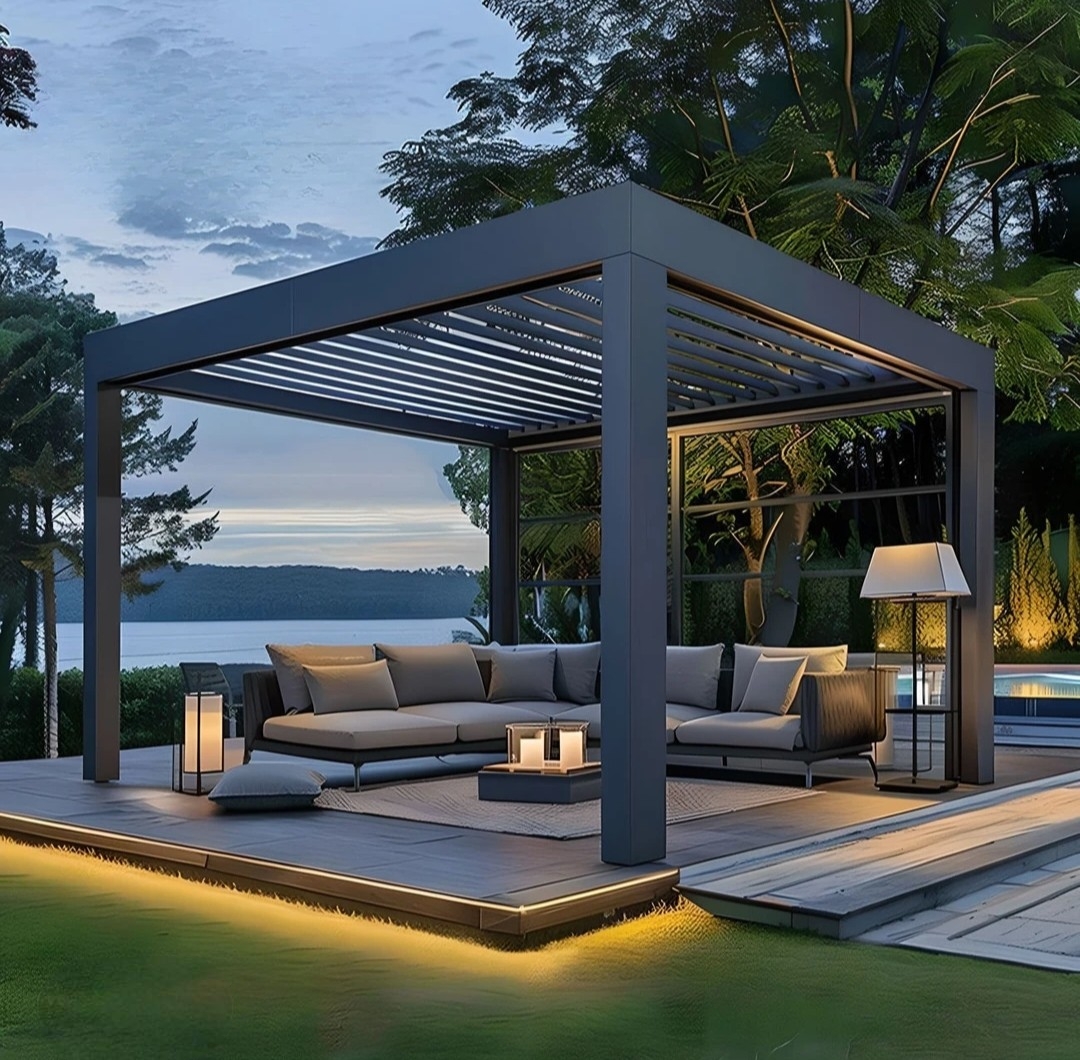
A louvered pergola is a freestanding or wall-attached aluminum structure with a roof made of rotating horizontal blades (louvers). The blades rotate 0–135° via motor — fully open for sky view, partially angled for filtered shade, or fully closed for 100% rain protection. Integrated gutters in the frame channel water through the posts.
Key characteristics: Freestanding or wall-attached, aluminum blade roof, adjustable shade angle, high wind resistance, permanent structure, higher cost.
👉 View Motorized Louvered Pergola product page →
3. Cost Comparison (2026 Prices)
| Size (W×P) | Full-Box Canopy (FOB) | Louvered Pergola (FOB) | Price Difference |
|---|---|---|---|
| 3×2m (small patio) | $400–$800 | $1,200–$2,000 | Pergola +150% |
| 4×3m (standard patio) | $700–$1,500 | $2,000–$3,500 | Pergola +130% |
| 5×4m (large patio) | $1,200–$2,500 | $3,000–$5,500 | Pergola +120% |
| 6×4m (commercial) | $1,800–$3,500 | $4,000–$7,000 | Pergola +100% |
| Installation (typical) | $300–$800 | $800–$2,500 | Pergola +200% |
Cost verdict: A full-box canopy is typically 50–60% cheaper than a comparable louvered pergola. The gap narrows slightly for larger sizes, but the canopy remains the budget leader. However, the pergola's longer lifespan (20+ years vs 10–12 for canopy fabric) narrows the lifetime cost gap.
4. Weather Protection: Rain, Sun & UV
☀️ Sun & UV Protection
Full-box canopy: Quality PVC fabric blocks 92–98% of UV. Dark colors block more. But it's binary — either full shade or no shade. You can't adjust for morning vs afternoon sun angle.
Louvered pergola: Closed aluminum blades block 100% of direct sun. But the magic is adjustability — angle the blades to block low-angle morning/evening sun while still letting in light and air. You get precise control over light and shade throughout the day.
Winner: 🏆 Louvered pergola (adjustable shade is a game-changer)
🌧️ Rain Protection
Full-box canopy: When extended with proper slope (15°+), PVC fabric is 100% waterproof. Water runs off. But if the slope is too flat or fabric loses tension, water pools and causes sagging/leakage. Also, wind-driven rain can get under the open sides.
Louvered pergola: Closed overlapping blades with integrated gutters create a 100% waterproof roof. Water is channeled through the posts — no dripping, no pooling. The rigid aluminum structure maintains its shape regardless of weather. Add zip screens on the sides and you block wind-driven rain too.
Winner: 🏆 Louvered pergola (more reliable waterproofing, integrated drainage)
🌡️ Heat & Airflow
Full-box canopy: Fabric absorbs some heat, and the closed canopy traps hot air underneath — can feel like a greenhouse in still conditions. No adjustable ventilation.
Louvered pergola: Partially angled blades allow hot air to escape while blocking direct sun — the "bioclimatic" effect. Even when closed, the air gap between overlapping blades provides some ventilation. Add ceiling fans and it's significantly cooler than a fabric canopy.
Winner: 🏆 Louvered pergola (bioclimatic ventilation)
5. Wind Resistance & Safety
This is the single biggest differentiator between the two systems — and the most important factor for many buyers.
| Condition | Full-Box Canopy | Louvered Pergola |
|---|---|---|
| Max safe wind (extended/closed) | Beaufort 5–6 (30–49 km/h) | Beaufort 8–10 (62–102 km/h) |
| Max safe wind (retracted/open) | Beaufort 10–12 (89–117 km/h) | Beaufort 10–12 (89–117 km/h) |
| Requires retraction in storm? | ✅ YES (mandatory) | ❌ No (open blades let wind pass) |
| Wind sensor needed? | 🔴 ESSENTIAL | 🟡 Recommended (auto-open) |
| Damage risk if left out in wind | 🔴 HIGH (tear, bend, pullout) | 🟢 LOW (rigid structure) |
The critical difference: A full-box canopy must be retracted when wind exceeds ~40 km/h. If you're not home, or the sensor fails, or power goes out — a sudden gust can destroy it. A louvered pergola simply needs the blades opened (0°) to let wind pass through — the structure itself remains solid even in 100 km/h wind.
Winner: 🏆 Louvered pergola (by a wide margin — especially for tropical/storm-prone areas)
6. Aesthetics & Design Flexibility
Full-Box Canopy Aesthetics
- Retracted: Nearly invisible — just a slim aluminum cassette on the wall. Clean, minimal, doesn't alter the building's architecture.
- Extended: Looks like a classic awning. Fabric can be solid color, striped, or even custom-printed. The articulated arms are visible underneath.
- Limitation: Only wall-mounted. Can't create a freestanding "room" feel. Sides are always open.
- Customization: Fabric color/pattern, cassette color (RAL), LED strip lighting option.
Louvered Pergola Aesthetics
- Always visible: The aluminum frame is a permanent architectural feature. Creates a defined "outdoor room" with posts and roof.
- Modern look: Clean lines, powder-coated aluminum, integrated LED lighting in the blades. Looks high-end and contemporary.
- Freestanding or attached: Can be placed anywhere in a garden/patio, not just against a wall. Creates a destination space.
- Expandable: Add zip screens for enclosure, ceiling fans, heaters, curtains, even outdoor kitchens under it.
- Customization: Frame color (RAL 200+ colors), blade color, LED color temperature, post style, size modularity.
Winner: Depends on preference. 🏆 Full-box canopy if you want minimal visual impact when retracted. 🏆 Louvered pergola if you want a defined outdoor room and architectural statement.
7. Maintenance & Lifespan
| Factor | Full-Box Canopy | Louvered Pergola |
|---|---|---|
| Frame lifespan | 15–20 years | 20–25+ years |
| Roof material lifespan | 8–12 years (fabric) | 20+ years (aluminum) |
| Roof replacement cost | $300–$800 (re-fabric) | Rarely needed |
| Annual maintenance time | 2–3 hours | 1–2 hours |
| Cleaning frequency | Quarterly (fabric stains) | 2x/year (hose down) |
| Mildew risk | 🔴 Higher (fabric) | 🟢 Low (aluminum) |
| Motor lifespan | 10,000+ cycles (15+ yrs) | 10,000+ cycles (15+ yrs) |
Winner: 🏆 Louvered pergola (lower maintenance, no fabric replacement, aluminum lasts decades)
8. Installation Complexity
Full-box canopy: Wall-mounted, 2–3 people, 4–8 hours. Requires a solid wall (concrete/brick/reinforced stud). Electrical connection for motor. No foundation needed. DIY-feasible for handy homeowners.
Louvered pergola: Freestanding models require concrete post footings (30–50cm deep, 2–3 days cure time). Wall-attached models skip footings but need structural wall attachment. Assembly is more complex (frame, blades, motor, gutters). 2–3 days for professional installation. Not recommended for DIY unless you have construction experience.
Winner: 🏆 Full-box canopy (faster, simpler, no concrete, DIY-friendly)
9. ROI & Resale Value
Residential Property Value
A louvered pergola is considered a permanent outdoor structure and typically adds 50–80% of its cost to home value (similar to a deck or patio upgrade). It's a visible, desirable feature that homebuyers will pay more for.
A full-box canopy is considered a semi-permanent fixture — it adds some value but less than a pergola, because buyers see it as something that may need replacement or removal.
Commercial ROI
For restaurants, cafes, and hotels, both systems generate revenue by increasing usable outdoor seating. However:
- Louvered pergola: Usable in more weather conditions (rain + wind) = more revenue days per year. Can add zip screens for full enclosure = year-round use.
- Full-box canopy: Must retract in wind = fewer usable days. Lower upfront cost = faster payback, but lower long-term revenue potential.
See our detailed ROI analysis for revenue calculations by business type.
Winner: 🏆 Louvered pergola (higher resale value, more revenue days, longer usable lifespan)
10. Best System by Scenario (Decision Matrix)
| Scenario | Best Choice | Why |
|---|---|---|
| Small residential patio (≤10m²), budget under $1,000 | Full-Box Canopy | Affordable, easy install, sufficient for light use |
| Medium patio (10–25m²), want all-weather use | Louvered Pergola | Adjustable shade, rainproof, wind-resistant, outdoor room feel |
| Freestanding garden structure (no wall to mount) | Louvered Pergola | Canopy is wall-mounted only; pergola is freestanding |
| Restaurant terrace (20–50 seats), tropical climate | Louvered Pergola | Withstands storms, usable year-round, add zip screens for enclosure |
| Cafe storefront awning, moderate climate | Full-Box Canopy | Classic awning look, retracts fully, lower cost, brand printing possible |
| Hotel pool area (large, 50m²+) | PVC Folding / Canopy | Large span, lower cost per m², full retraction for star-gazing events |
| Want to add side screens / heaters / fans | Louvered Pergola | Structure supports accessories; canopy has no frame to mount to |
| Minimal visual impact when not in use | Full-Box Canopy | Retracts into slim cassette, nearly invisible |
| High wind / storm-prone area | Louvered Pergola | Open blades let wind pass; canopy must retract (risk if sensor fails) |
11. Frequently Asked Questions
Can I install a full-box canopy on a louvered pergola?
Not typically — they're separate systems. However, some projects combine them: a louvered pergola for the main area and a full-box canopy for an attached extension. Or you can add zip screens to the sides of a pergola for full enclosure without needing a canopy.
Which one is better for rain — canopy or pergola?
A louvered pergola with closed blades is more reliably waterproof because the rigid aluminum structure doesn't sag, and integrated gutters channel water away. A full-box canopy is also waterproof when properly tensioned and sloped, but it's more prone to water pooling if the fabric loses tension over time. Both work — the pergola is more foolproof.
Do I need a permit for either system?
Wall-mounted awnings under 3–4m projection usually don't need a permit. Freestanding pergolas over a certain size (often 10–15m² or 3m height) may require a building permit. Commercial installations almost always need approval. Always check with your local building department. AluShed provides engineering drawings for permit applications.
Can both systems be motorized and smart-controlled?
Yes. Both systems offer tubular motors, remote control, WiFi/app control, and sensor integration (wind, rain, sun). The motor technology is essentially the same. The difference is what the motor moves: a fabric roller (canopy) or rotating aluminum blades (pergola).
Which system has better resale value for my home?
A louvered pergola typically adds more resale value (50–80% of cost) because it's a permanent, desirable outdoor structure. A full-box canopy adds less (20–40%) because it's viewed as a semi-permanent fixture that may need replacement. If you're planning to sell within 3–5 years, the pergola is the better investment.
What if I can't decide — can I start with a canopy and upgrade later?
Yes, many homeowners start with an affordable full-box canopy, then upgrade to a louvered pergola when budget allows. The wall-mounted canopy doesn't prevent future pergola installation. However, if you know you'll eventually want a pergola, it may be more cost-effective to save up and buy the pergola directly, rather than buying a canopy and then replacing it within a few years.
Still Not Sure Which System Is Right for You?
Send us photos and dimensions of your space. We'll recommend the best system, provide a free CAD layout, and give you factory-direct pricing for both options — so you can compare side by side.
🔗 Related Articles & Products
- Louvered Pergola vs Retractable Roof: Full Technical Comparison
- PVC Folding Awning Complete Buying Guide
- Motorized Louvered Pergola Buying Guide 2026
- Outdoor Shading for Tropical Climate: Malaysia & SEA
- Commercial Outdoor Shading ROI Analysis
- Full-Box Retractable Canopy — Product Page
- Motorized Louvered Pergola — Product Page
- PVC Folding Awning — Product Page
- Windproof Zip Screen — Product Page
- View All Blog Articles →