
PVC Folding Awning Buying Guide 2026: Retractable Folding Roof for Large Outdoor Spaces
Published September 18, 2026 · By AluShed Team · 10 min read
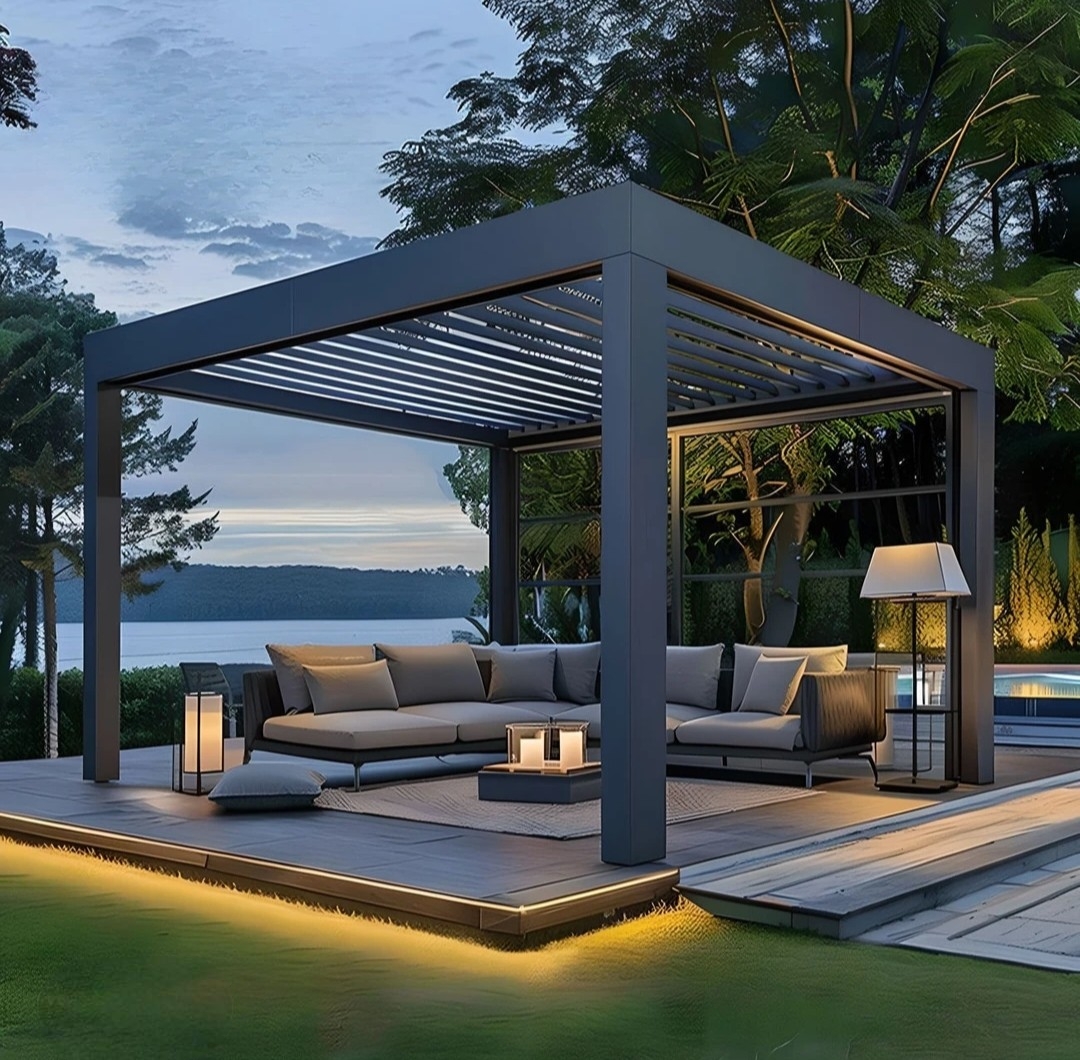
A PVC folding retractable awning costs /m虏 factory direct, covers spans up to 7鈥?m, and opens/closes in 45鈥?0 seconds. Choose German PVC membrane (850 g/m虏) for 10+ year fabric life, integrated drainage for rain, and wind/rain sensors for unattended operation. Best for large commercial terraces (restaurants, hotels) where a louvered pergola is too expensive or spans exceed 6m. Budget /m虏 installed, expect 10鈥?5 year fabric lifespan, and replace the membrane once during the frame's 25-year life.
When you need to cover a large outdoor space — a restaurant terrace, hotel pool area, event courtyard, or residential patio over 20m² — a traditional louvered pergola may not be the most cost-effective choice. That's where a PVC folding awning (also called a retractable folding roof, sliding canopy, or folding arm awning) comes in. It spans wider, costs less per square meter, and fully retracts to open sky when you want it.
But not all PVC folding awnings are created equal. Cheap systems sag, leak, tear in wind, and burn out motors within 2 years. In this guide, we break down everything you need to know — from fabric grades and motor types to wind resistance, installation, and pricing — so you can buy with confidence.
📑 Table of Contents
- What Is a PVC Folding Awning?
- PVC Folding Awning vs Louvered Pergola: Which to Choose?
- 4 Types of Retractable Folding Roof Systems
- PVC Fabric Grades: How to Choose the Right Material
- Motorization & Control Options
- Wind Resistance & Weather Performance
- Installation Guide: What to Expect
- Pricing & Cost Factors (2026)
- Maintenance & Care Tips
- Frequently Asked Questions
1. What Is a PVC Folding Awning?
A PVC folding awning is a retractable roof system consisting of:
- Aluminum or galvanized steel frame — articulated arms or sliding tracks that support the fabric
- PVC-coated polyester fabric — waterproof, UV-resistant, available in various colors and opacities
- Motor or manual crank — extends and retracts the roof along the frame
- Control system — remote, wall switch, smartphone app, or sensor (wind/rain/sun)
When extended, the fabric is tensioned across the frame, creating a waterproof, shaded canopy. When retracted, it folds compactly against a wall or into a protective cassette — leaving the space completely open to the sky.
Key advantage: PVC folding awnings can span up to 15 meters wide in a single unit — far beyond the 6–7m maximum of most louvered pergolas. This makes them the go-to choice for large commercial spaces.
2. PVC Folding Awning vs Louvered Pergola: Which to Choose?
This is the most common question we get. Both systems have strengths — the right choice depends on your space, budget, and priorities.
| Factor | PVC Folding Awning | Louvered Pergola |
|---|---|---|
| Max span (single unit) | Up to 15m | 6–7m (modular for larger) |
| Cost per m² | $80–$180 | $200–$400 |
| Wind resistance (extended) | Beaufort 5–6 (30–50 km/h) | Beaufort 8–10 (62–102 km/h) |
| Waterproof when extended | ✅ Yes (if properly tensioned) | ✅ Yes (closed louvers) |
| Adjustable shade | ❌ Full or nothing | ✅ 0–135° blade angle |
| Fully retracts to open sky | ✅ Yes | ❌ Frame always visible |
| Fabric lifespan | 8–12 years (then replace) | N/A (aluminum lasts 20+ yrs) |
| Installation complexity | Medium (wall-mounted) | High (freestanding or attached) |
| Best for | Large areas, budget, full retraction | Medium areas, all-weather, premium look |
- Space under 25m² and want all-weather use → Louvered Pergola
- Space over 25m² or budget is the top priority → PVC Folding Awning
- Need adjustable shade (not just open/closed) → Louvered Pergola
- Want completely open sky when retracted → PVC Folding Awning
- High wind area and can't retract manually → Louvered Pergola (with wind sensor auto-open)
3. 4 Types of Retractable Folding Roof Systems
① Wall-Mounted Folding Arm Awning
The most common type. Articulated arms extend from a wall-mounted cassette, pushing the fabric out horizontally. Projection typically 2–4m, width up to 12m. Ideal for patios, balconies, and storefronts attached to a building.
Best for: Residential patios, cafe storefronts, small commercial spaces with a wall to mount to.
② Freestanding / Dual-Post Folding Roof
Supported by two or more posts (no wall needed), the fabric slides along horizontal tracks between the posts. Can span larger areas and is freestanding — perfect for pools, gardens, and courtyards not attached to a building.
Best for: Pool areas, freestanding patios, event spaces, large gardens.
③ Sliding / Track-Mounted Folding Canopy
The entire roof structure slides along tracks mounted on existing walls or posts — like a curtain that opens and closes. Multiple modules can be linked to cover very large areas (up to 100m²+). When open, the modules stack neatly at one end.
Best for: Restaurant terraces, hotel courtyards, large event spaces, between two buildings.
④ Full-Box Cassette Awning
A premium variant where the fully retracted fabric and arms are enclosed in an aluminum cassette (box), protecting them from weather, dirt, and UV when not in use. This extends fabric and mechanism lifespan significantly. The cassette can be wall-mounted or integrated into the building facade.
Best for: Luxury residential, high-end commercial, coastal areas (salt protection), minimal maintenance desired.
👉 Related: Full-Box Retractable Canopy product page for the premium cassette option.
4. PVC Fabric Grades: How to Choose the Right Material
The fabric is the most critical component — it determines waterproofing, UV protection, lifespan, and appearance. Here's what to look for:
Fabric Construction
Quality PVC awning fabric is a polyester scrim (base mesh) coated on both sides with PVC. The polyester provides tensile strength, while the PVC provides waterproofing and UV resistance. Key specifications:
| Grade | Weight (g/m²) | Lifespan | UV Block | Best For |
|---|---|---|---|---|
| Economy | 280–350 | 3–5 yrs | 85–90% | Temporary / budget |
| Standard | 450–550 | 7–10 yrs | 92–95% | Residential, light commercial |
| Premium | 600–750 | 10–15 yrs | 96–98% | Commercial, coastal, high UV |
| Architectural | 800–1000+ | 15–20 yrs | 98–99% | Luxury, public buildings |
Fabric Features to Insist On
- PVC coating on BOTH sides — single-sided coating delaminates faster
- UV-stabilized formulation — look for "UV resistant" or "UV stabilized" in specs
- Mildew & mold resistant — essential for humid climates (Malaysia, Singapore, Southeast Asia)
- Cold crack resistance — for climates with temperature swings
- Flame retardant — required for commercial installations in most countries
- Self-cleaning coating — premium fabrics have a surface treatment that makes dirt wash off with rain
Color Choice Matters
Light colors (white, beige, light gray) reflect heat and keep the space cooler underneath, but show dirt more. Dark colors (dark gray, black, navy) absorb more heat but hide dirt and provide better glare reduction. For tropical climates, we recommend light gray or beige to minimize heat buildup.
5. Motorization & Control Options
Manual Crank vs Motorized
Manual crank: Cheaper upfront, but impractical for anything over 4m wide. Takes 1–2 minutes to fully extend/retract, and the gearing wears out faster with frequent use. Only suitable for small residential awnings used occasionally.
Motorized: The standard for any commercial installation or awning over 4m. A tubular motor sits inside the roller tube and extends/retracts the fabric in 30–60 seconds at the push of a button. Motors are rated for 10,000+ cycles — that's daily use for 25+ years.
Motor Types
- AC tubular motor (230V): Most common, reliable, high torque. Suitable for all sizes. Brands: Somfy, Simu, Dooya, or equivalent Chinese premium.
- DC motor (24V): Lower voltage, safer, can run on solar + battery. Good for remote locations or where running power is difficult. Slightly lower torque.
- Smart motor (WiFi / RF): Built-in receiver for app control, voice control (Alexa/Google Home), and sensor integration. The future-proof choice.
Control Options
| Control Type | Cost | Best For |
|---|---|---|
| Remote control (RF) | $30–$80 | Standard residential, single awning |
| Wall switch | $20–$50 | Commercial, fixed location, staff operation |
| Smartphone app (WiFi) | $80–$200 | Tech-savvy users, remote monitoring, multiple awnings |
| Wind sensor (auto-retract) | $80–$250 | ESSENTIAL for commercial — protects investment when you're away |
| Sun sensor (auto-extend) | $80–$200 | Energy saving, automatic shade when sun hits |
| Rain sensor (auto-extend) | $60–$150 | Protect outdoor furniture, automatic rain coverage |
6. Wind Resistance & Weather Performance
This is the #1 limitation of PVC folding awnings and the most misunderstood factor. Let's be clear:
A PVC folding awning is NOT designed to stay extended in high wind. The fabric acts like a sail — wind creates uplift and lateral force that can damage the mechanism. Every manufacturer specifies a maximum safe wind speed for extended operation.
Wind Rating by System Type
| System Type | Max Safe Wind (Extended) | Beaufort Scale |
|---|---|---|
| Folding arm awning (standard) | 30–38 km/h | 5 |
| Folding arm awning (heavy-duty) | 39–49 km/h | 6 |
| Track-mounted sliding canopy | 39–61 km/h | 6–7 |
| Full-box cassette (premium) | 39–49 km/h | 6 |
When retracted (folded into cassette): All systems can withstand much higher wind — typically Beaufort 10–12 (89–117 km/h) — because the fabric is folded and protected, not acting as a sail.
Rain Performance
When properly tensioned and pitched at the correct angle (minimum 15° slope), a quality PVC awning is 100% waterproof. Water runs off the fabric surface. Problems occur when:
- The slope is too flat — water pools, causing sagging and eventual leakage
- The fabric loses tension over time — creates low spots where water collects
- Snow or heavy debris accumulates — adds weight beyond design limits
Solution: Choose a system with adjustable tension, ensure proper installation slope, and retract during heavy snow or prolonged rain if pooling occurs.
7. Installation Guide: What to Expect
Wall-Mounted Awning Installation Steps
- Site survey & measurement (1–2 hours): Confirm wall structure, mounting height, projection, and electrical access. Wall must be solid (concrete, brick, or reinforced stud — not drywall alone).
- Mark mounting points (30 min): Drill template marks on the wall, ensuring level alignment.
- Drill & install brackets (1–2 hours): Use appropriate anchors (expansion bolts for concrete, lag bolts for wood). Minimum 4–6 brackets depending on width.
- Mount the cassette/roller tube (30–60 min): Lift the assembled unit onto the brackets (2–3 people needed for wide units).
- Install & adjust arms (1–2 hours): Attach articulated arms, adjust tension and pitch angle.
- Electrical connection (30–60 min): Wire motor to power supply, install receiver, pair remote. Must be done by a licensed electrician in most jurisdictions.
- Test & calibrate (30 min): Full extend/retract cycles, set end limits, test sensors.
- Cleanup & handover (30 min): Remove packaging, demonstrate operation, provide warranty docs.
Total installation time: 4–8 hours for a standard wall-mounted unit (1–2 days for large or complex installations).
Freestanding / Track-Mounted Installation
More complex — requires post foundations (concrete footings 30–50cm deep), track alignment, and often structural engineering for large spans. Allow 2–4 days for a typical freestanding system.
DIY vs Professional Installation
DIY is possible for small wall-mounted awnings (under 4m) if you're handy with tools and electrical work. However:
- Improper mounting can cause the awning to fall (safety hazard)
- Incorrect pitch causes water pooling and fabric damage
- Electrical work may require a permit and licensed electrician
- Warranty may be void if not installed by a certified professional
Recommendation: For any unit over 4m wide, any commercial installation, or any freestanding system — hire a professional. The $300–$800 installation cost is cheap insurance.
8. Pricing & Cost Factors (2026)
Pricing varies dramatically based on size, type, fabric grade, motor, and accessories. Here are factory-direct FOB price ranges (excluding shipping and installation):
| System Type | Size (W×P) | FOB Price Range | Installed (est.) |
|---|---|---|---|
| Manual folding arm | 3×2m | $200–$400 | $400–$700 |
| Motorized folding arm | 4×3m | $500–$1,200 | $900–$2,000 |
| Motorized folding arm (large) | 6×3.5m | $1,000–$2,500 | $1,800–$4,000 |
| Full-box cassette (premium) | 5×3m | $1,500–$3,500 | $2,500–$5,500 |
| Freestanding dual-post | 6×4m | $2,000–$4,500 | $3,500–$7,000 |
| Track-mounted sliding (commercial) | 10×5m | $4,000–$10,000 | $7,000–$16,000 |
Factors That Increase Price
- Size: Larger units need stronger motors, more brackets, more fabric — price scales roughly with area
- Fabric upgrade: Premium (600+ g/m²) adds 30–50% vs standard
- Full-box cassette: Adds 40–60% vs open roller
- Sensors: Wind + sun + rain sensors add $200–$500 total
- Smart control: WiFi/app/voice adds $80–$200
- Freestanding posts: Adds $500–$1,500 vs wall-mounted
- Custom colors / branding: Custom RAL colors or printed logos add $100–$300
- Shipping & installation: Typically 30–60% of FOB price for international orders
9. Maintenance & Care Tips
A well-maintained PVC folding awning can last 10–15 years. Neglected, it may fail in 3–5 years. Follow this schedule:
Monthly (5 minutes)
- Extend and retract fully once — keeps mechanism lubricated and prevents fabric from sticking
- Visually inspect for tears, loose stitching, or sagging
- Check that mounting brackets are tight
Quarterly (30 minutes)
- Hose down the fabric with plain water (low pressure) to remove dust and dirt
- Clean sensors (wind anemometer, rain sensor) with a soft cloth
- Check motor operation — listen for unusual noises
- Inspect sealant around mounting brackets (re-caulk if cracked)
Annually (1–2 hours)
- Deep clean fabric with mild soap (e.g., Woolite) and soft brush — NEVER use abrasive cleaners, bleach, or pressure washer
- Lubricate moving parts (arm joints, roller tube ends) with silicone spray — NOT oil-based lubricants (attract dirt)
- Check and retighten all fasteners
- Verify wind sensor calibration (test with a fan or compare to local weather data)
- Inspect fabric for mildew (treat with mildew remover if found — don't let it spread)
Seasonal / Weather-Related
- Before storm season: Test wind sensor auto-retract, ensure manual override works
- During heavy snow: Retract the awning (snow load can exceed design limits)
- After heavy rain: Extend to dry the fabric if it was retracted wet (prevents mildew)
- Long periods of non-use: Retract into cassette (if full-box) or cover with protective sleeve
- Never use a pressure washer on the fabric (destroys PVC coating)
- Never leave the awning extended in wind above its rating
- Never retract a wet/dirty awning for long periods (mildew grows)
- Never hang anything from the awning (lights, plants, decorations — adds load)
- Never use bleach or solvent-based cleaners
10. Frequently Asked Questions
How long does a PVC folding awning last?
With proper maintenance: fabric 8–12 years, frame and motor 15–25 years. The fabric is the consumable component — when it fades, tears, or leaks, you can replace just the fabric (typically $300–$800) without replacing the entire system. Premium 600+ g/m² fabric with UV stabilization lasts the longest.
Can a PVC folding awning be used in the rain?
Yes, when properly installed with a minimum 15° slope and correct tension, a quality PVC awning is fully waterproof. Rain runs off the surface. However, you should retract it during heavy storms with wind above the rating, as wind-driven rain can get under the edges and wind can damage the mechanism.
What's the maximum size for a single PVC folding awning?
Wall-mounted folding arm awnings typically max out at 12m wide × 4m projection. Track-mounted sliding systems can go up to 15m wide × 7m projection in a single module. For larger areas, multiple modules can be linked together with a shared drainage system — covering 100m²+ is common for commercial projects.
Do I need a building permit for a retractable awning?
In most jurisdictions, wall-mounted awnings under a certain projection (often 3–4m) do not require a permit. Freestanding structures, awnings over public sidewalks, or commercial installations usually do require approval. Always check with your local building department. AluShed can provide engineering drawings and structural calculations for permit applications.
Can I add side screens to a PVC folding awning?
Absolutely. Adding windproof zip screens to the sides of a PVC folding awning creates a fully enclosed outdoor room — blocking wind, rain, insects, and low-angle sun. This is a popular upgrade for restaurants and cafes that want to use the space year-round. The screens can be motorized and integrated with the same control system.
How do I choose between a PVC folding awning and a louvered pergola?
See our detailed comparison guide. Quick answer: PVC folding awning for large areas, budget sensitivity, and full retraction to open sky. Louvered pergola for medium areas, all-weather reliability, adjustable shade, and premium aesthetics. Many commercial projects use both — a louvered pergola for the main dining area and a PVC folding awning for the overflow/event space.
Ready to Get a PVC Folding Awning Quote?
Send us your dimensions and photos. We'll provide a free CAD layout + factory-direct quote within 12 hours. OEM/ODM available for distributors. Worldwide shipping from Foshan, China.
🔗 Related Articles & Products
- Louvered Pergola vs Retractable Roof: Full Comparison
- Outdoor Shading for Tropical Climate: Malaysia & SEA Guide
- Commercial Outdoor Shading ROI: Restaurants & Hotels
- Windproof Zip Screens Complete Guide
- PVC Folding Retractable Awning — Product Page
- Full-Box Retractable Canopy — Product Page
- Motorized Louvered Pergola — Product Page
- View All Blog Articles →